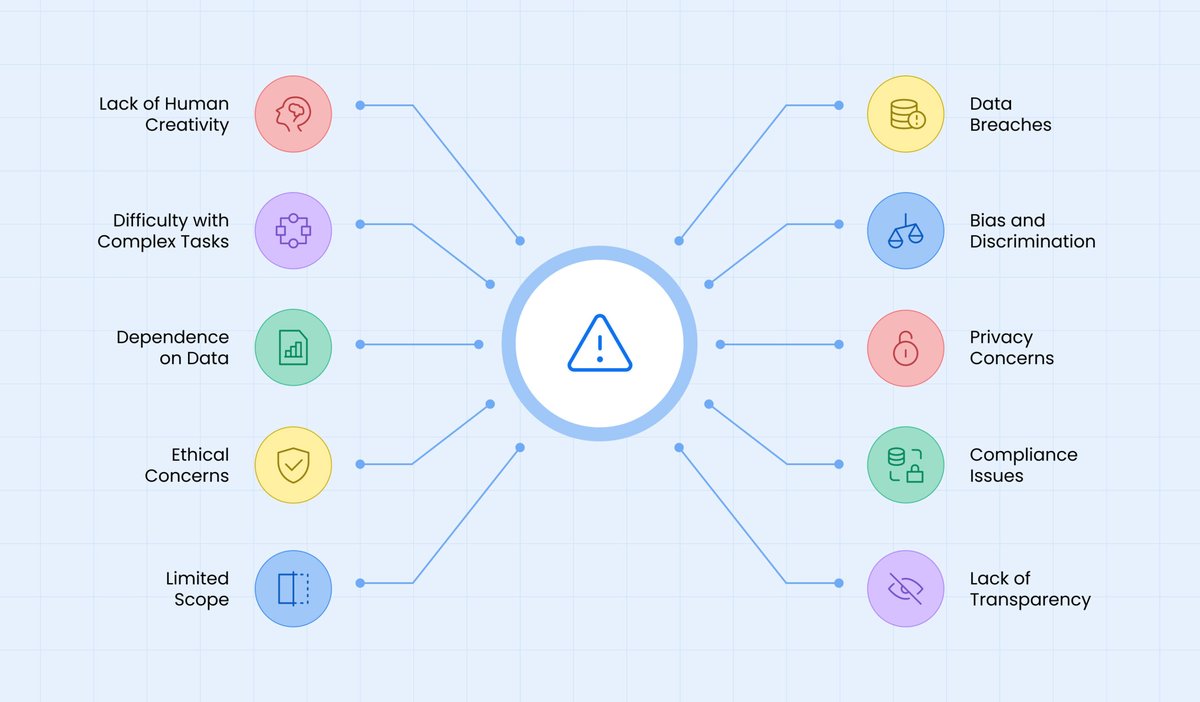
The promise of artificial intelligence is vast, but as we dive deeper into its capabilities, particularly with the rise of generative AI, it's crucial to acknowledge the less glamorous side of the coin. Truly understanding the limitations and challenges of generative AI isn't about stifling innovation; it's about fostering responsible development and deployment, ensuring we build tools that are not just powerful, but also reliable, ethical, and safe. The hype often eclipses the inherent flaws and operational hurdles that demand our attention if we want to harness this transformative technology effectively.
At a Glance: Generative AI's Hidden Obstacles
- Data is Destiny: AI outputs are only as good, unbiased, and comprehensive as the data they train on. Flawed data equals flawed results.
- Trust Issues: Many AI systems are "black boxes," making their decisions hard to understand or explain, which is a major concern in critical applications.
- Fragile Intelligence: Generative AI can be surprisingly easy to trick or mislead with subtle, malicious inputs.
- Mimicry, Not Minds: While impressive, AI's "creativity" is pattern recognition and remixing, not genuine understanding, empathy, or novel thought.
- Costly & Carbon-Heavy: Developing and running these systems demands immense computational power, making them expensive and environmentally impactful.
- The Hallucination Habit: Expect AI to occasionally invent plausible-sounding but entirely false information.
- Business Hurdles: Integrating AI involves navigating complex issues around data privacy, quality control, ethics, legal compliance, and substantial costs.
- Real Risks: From accidental IP disclosure to model drift and potential legal liabilities due to bias or false information, the risks are diverse and significant.
- Mitigation is Key: Proactive strategies, robust governance, diverse teams, and continuous policy updates are essential to manage these challenges.
The Unseen Side of Innovation: Why Understanding AI's Flaws Matters
Generative AI, exemplified by systems like DALL-E generating images from text or what ChatGPT generative AI is producing human-like conversation, has opened up exciting new frontiers. From automating content creation in marketing to assisting in design and revolutionizing entertainment, its potential seems boundless. But focusing solely on the "what it can do" without thoroughly grasping the "what it can't (yet)" or "what it struggles with" is a recipe for disappointment, risk, and even harm.
These systems are not magical oracles; they are sophisticated algorithms learning from vast datasets. Just like any tool, they have specific design parameters, inherent weaknesses, and operational challenges that demand careful consideration before widespread adoption, especially in business and critical societal applications. Let's peel back the layers and examine these critical limitations and practical hurdles.
Core Limitations: Where Generative AI Falls Short
Before we even consider deploying generative AI, it's vital to grasp its fundamental architectural weaknesses. These aren't just minor kinks; they are intrinsic characteristics that define the boundaries of what this technology can reliably achieve today.
The Data Dependency Trap: Quality In, Quality Out
At its heart, generative AI is a master of mimicry, learning patterns from the data it's fed during training. This makes it inherently data-dependent. If the training data is limited in scope, contains biases, is outdated, or simply flawed, the AI's outputs will inevitably reflect those imperfections. Think of it like a chef who only learns from recipes with missing ingredients or incorrect measurements – the resulting dishes will be inconsistent, incomplete, or simply wrong.
This isn't just about accuracy; it's also about representation. If your data doesn't adequately represent certain demographics or situations, the AI will struggle to perform well in those contexts, potentially leading to exclusion or poor service.
The Black Box Dilemma: Explaining the Unexplainable
Many advanced generative AI models operate as "black boxes." This means that while they can produce impressive outputs, the internal decision-making process—how they arrived at a specific conclusion or generated a particular piece of content—is often opaque and incomprehensible to humans.
This lack of transparency is a significant hurdle, especially in fields where accountability and explainability are paramount. Imagine an AI recommending a critical medical treatment or approving a loan application without being able to explain its reasoning. In such scenarios, the "why" can be as important as the "what," making the black box nature a major blocker for trust and regulatory compliance.
Deceptively Fragile: How Easily AI Can Be Fooled
Despite their apparent sophistication, generative AI systems can be surprisingly brittle. Subtle, often imperceptible, changes to input data can lead to drastically different and often erroneous outcomes. This vulnerability is not just a theoretical concern; it opens the door to adversarial attacks, where malicious actors intentionally craft misleading data to trick the AI into producing harmful or incorrect results.
For example, a slight tweak to an image, invisible to the human eye, could cause an AI to misclassify a stop sign as a yield sign, with potentially dangerous real-world consequences. This inherent fragility underscores the need for robust security measures and continuous validation.
Mimicry, Not Mastery: The Illusion of Creativity and Context
Generative AI is excellent at remixing existing data and patterns to create seemingly "new" content. However, this is distinct from genuine creativity, which often involves truly novel ideas, abstract reasoning, and deep contextual understanding. AI lacks the capacity for complex human attributes like:
- Cultural Nuances: It can't inherently grasp the subtle social meanings or historical contexts that shape human interaction.
- Emotional Intelligence: It can mimic emotional language but doesn't feel or understand emotions.
- Ethical Considerations: It doesn't have a moral compass or an innate sense of right and wrong; it merely reflects the ethical frameworks present (or absent) in its training data.
Its "creativity" is a sophisticated form of extrapolation, not independent thought. It doesn't understand the world in the way a human does, limiting its ability to produce truly innovative or contextually appropriate content without human oversight.
Stuck in Its Lane: Generalization Gaps
Generative AI models excel at tasks that closely resemble the data they were trained on. However, they struggle to generalize beyond their training data. Present them with new, unseen scenarios or tasks significantly different from what they've learned, and their performance can degrade rapidly.
This means that a model trained extensively on historical financial reports might struggle to predict trends in an entirely new economic climate or interpret data from an industry it's never encountered. Continuous updates and expensive retraining are often required to keep these models relevant and effective in a dynamic world.
The Resource Hunger: Costly & Carbon-Intensive
Developing and operating cutting-edge generative AI models demands an astronomical amount of computational resources. This includes powerful processing units (GPUs), massive data storage, and significant energy consumption. Consequently, these systems are:
- Expensive: The costs associated with hardware, software licenses, and specialized talent can be prohibitive for smaller entities.
- Less Accessible: The financial and technical barriers mean that only well-funded organizations can fully leverage state-of-the-art AI.
- Environmentally Impactful: The enormous energy demands of data centers contribute to carbon footprints, raising legitimate environmental concerns that require sustainable solutions.
The Hallucination Headache: When AI Makes Things Up
One of the most perplexing limitations of Large Language Models (LLMs) within generative AI is their propensity for confabulation or "hallucinations." This refers to the unpredictable generation of false, nonsensical, or made-up information presented with an air of absolute confidence.
An LLM might invent non-existent facts, cite fabricated sources, or provide entirely incorrect answers to factual questions, all while maintaining a convincing tone. Identifying these hallucinations can be challenging, especially as the quality of AI output improves, making rigorous human fact-checking an indispensable step.
Mirroring Our Flaws: The Persistent Problem of AI Bias
AI systems, despite their mathematical foundations, are not inherently impartial. They reflect the biases embedded in their training data or introduced during the training process. This AI bias can lead to discriminatory outputs that perpetuate societal inequities.
For instance, an AI used in loan applications might unfairly disadvantage certain demographic groups if its training data contained historical lending biases. Similarly, an AI-powered resume screening tool could inadvertently favor one gender or ethnicity over another if it learned from biased hiring patterns. Addressing and mitigating AI bias is a complex, ongoing ethical and technical challenge.
Reasoning's Rough Edges: Subtle Gaps in Logic
While generative AI can mimic sophisticated reasoning, it often exhibits gaps in genuine logical comprehension. It can connect ideas based on statistical patterns, but it doesn't necessarily understand cause and effect, fundamental physics, or abstract concepts in the same way a human does.
These reasoning gaps can be particularly challenging to identify because the AI's output might sound perfectly logical and coherent, even when it contains subtle fallacies or misinterpretations. This underscores the need for domain expertise in reviewing AI-generated content, especially in fields requiring precise logical deduction.
Navigating the Minefield: Business Challenges of Generative AI Adoption
Beyond the inherent technical limitations, businesses looking to integrate generative AI face a unique set of operational and strategic challenges. These aren't just about the technology itself, but about how it interacts with existing systems, regulations, and human processes.
Safeguarding the Digital Core: Data Privacy & Security
The sheer volume of data required to train and operate generative AI models presents enormous data privacy and security challenges. Businesses must ensure the privacy of sensitive customer information, proprietary data, and employee details, especially when these are used as training inputs or processed by AI systems.
Adherence to stringent regulations like GDPR, CCPA, and industry-specific compliance standards is not optional. Robust cybersecurity measures are essential to protect against breaches, unauthorized access, and malicious manipulation of AI models and their data streams. A lapse here can lead to significant fines, reputational damage, and loss of customer trust.
The Quality Control Conundrum: Ensuring Reliable Outputs
While generative AI can produce content at scale, maintaining consistent quality and reliability is a significant ongoing challenge. The unpredictability of hallucinations, biases, and generalization gaps means that AI output often requires rigorous human quality checks and editorial oversight.
This necessitates establishing clear metrics for success, implementing iterative testing, and developing sophisticated monitoring systems. Relying blindly on AI-generated content without human validation can lead to factual errors, inappropriate messaging, or even legal liabilities.
Beyond Code: Tackling Ethical & Bias Concerns
Businesses have a moral and often legal imperative to actively identify and mitigate biases and ethical concerns within their AI models. This goes beyond technical fixes; it requires a proactive, multidisciplinary approach involving ethicists, legal experts, and diverse user groups.
Ignoring these concerns can lead to discriminatory outputs, harm to individuals, erosion of brand reputation, and costly lawsuits. Establishing clear ethical guidelines for AI development and deployment is no longer a luxury but a necessity.
Integrating the New with the Old: System Compatibility
Incorporating generative AI into existing business systems and workflows can be surprisingly complex. Many legacy systems weren't designed to interact seamlessly with advanced AI models, leading to significant integration challenges.
This often requires substantial modifications to IT infrastructure, data pipelines, and operational processes. The effort involves not just technical work but also change management to ensure employees can effectively adopt and utilize the new AI-powered tools without disrupting established workflows.
The Price Tag of Progress: Costs & Resource Allocation
As highlighted earlier, the costs and resource allocation for generative AI are substantial. Beyond the initial investment in computing power and high-quality training data, businesses must account for ongoing maintenance, retraining, and the hiring of specialized talent (AI engineers, data scientists, ethicists).
Furthermore, the environmental impact of these resource-intensive operations is a growing concern, requiring businesses to consider sustainable practices and energy-efficient solutions in their AI strategies.
Regulatory Rapids: Staying Compliant in a Shifting Landscape
The legal landscape surrounding AI is rapidly evolving and varies significantly across different countries and jurisdictions. Businesses operating globally face the immense challenge of navigating continually changing regulatory compliance requirements for AI.
This includes laws related to data privacy, intellectual property, algorithmic transparency, bias detection, and consumer protection. A comprehensive legal strategy and proactive engagement with regulatory bodies are crucial to avoid penalties and legal entanglements.
Scaling Smart: Performance & Growth
As businesses grow, their AI systems must be able to keep pace. Ensuring that generative AI systems can handle increased loads and process larger volumes of data without compromising performance or accuracy is a critical scalability and performance challenge.
This requires robust infrastructure, efficient algorithms, and careful architectural planning. A poorly scaled AI system can quickly become a bottleneck, negating the very benefits it was designed to provide.
Building Bridges of Trust: User Acceptance & Transparency
Gaining and maintaining user trust and acceptance is paramount for successful AI adoption. Users, whether employees or customers, need to understand how AI works, what its limitations are, and how their data is being used.
Transparency about the AI's capabilities and boundaries, along with ensuring reliable, understandable, and fair outputs, is essential. A lack of trust can lead to resistance, low adoption rates, and a negative perception of AI within the organization or among the customer base.
Who Owns What? Intellectual Property Rights
The question of intellectual property rights for AI-generated content is a complex and evolving legal area. Determining ownership of content created by an AI, especially when it draws heavily on copyrighted training data, remains largely unresolved.
Businesses must navigate these uncertainties, potentially facing challenges with copyright claims, licensing agreements, and the protection of their own AI-generated assets. Clear policies and legal counsel are essential to mitigate these risks.
The Perpetual Race: Keeping Pace with Tech Evolution
The field of AI is moving at an unprecedented pace. New models, algorithms, and applications emerge constantly. For businesses, this creates the challenge of keeping up with technological advances and continuously adapting their strategies and systems.
This demands ongoing investment in research and development, continuous learning for teams, and the agility to incorporate new developments into business strategies before they become outdated. Stagnation in AI is equivalent to falling behind.
The Human-AI Symphony: Optimizing Collaboration
Finally, effectively leveraging generative AI isn't about replacing humans but about augmenting them. Finding the optimal balance between human and AI contributions in workflows requires a deep understanding of their respective strengths and limitations.
This involves designing collaborative processes where AI handles repetitive or data-intensive tasks, freeing humans to focus on higher-level creativity, critical thinking, ethical oversight, and nuanced decision-making. Poorly designed human-AI collaboration can lead to frustration, inefficiency, and missed opportunities.
Understanding the Fallout: Categorized Risks of Generative AI
Beyond the operational challenges, there are distinct categories of risks that can have significant detrimental impacts on organizations leveraging generative AI. Being aware of these helps in crafting robust mitigation strategies.
Under the Hood: Functional Risks
These risks relate to the inherent behavior and integrity of the AI model itself.
- Model Drift: Over time, an AI model's performance can gradually degrade as the real-world data it encounters diverges from its training data. This model drift can lead to declining accuracy, outdated recommendations, and a loss of alignment with its intended purpose, necessitating costly and time-consuming retraining efforts.
- Data Poisoning: A more insidious functional risk is data poisoning, where malicious actors intentionally corrupt the data streams used to train or fine-tune models. This can inject biases, backdoors, or vulnerabilities into the AI, causing it to produce harmful outputs or behave unexpectedly.
In the Trenches: Operational Risks
These risks impact day-to-day operations and resource utilization.
- Waste of Resources: Relying on incorrect AI-generated advice, using biased outputs, or deploying a model corrupted by data poisoning can lead to significant waste of resources. This includes time, money, and missed opportunities, ultimately impacting business efficiency and profitability.
- Unwanted Disclosure of Confidential Intellectual Property (IP): Through clever or malicious prompt engineering, an AI tool can sometimes be coaxed into revealing sensitive information, trade secrets, or confidential data it encountered during its training or previous interactions. This unwanted disclosure of confidential IP can severely undermine competitive advantages and lead to significant financial losses.
The Legal Landscape: Legal Risks
These are the potential liabilities and penalties organizations might face.
- Harm from False Information: If an organization's AI tools generate and disseminate false or misleading information that causes harm to consumers, employees, or other stakeholders, the organization can face civil actions, lawsuits, and regulatory penalties. The "hallucination" problem makes this a particularly pertinent concern.
- Discrimination from Bias: As discussed, biases in AI tools can lead to discriminatory outcomes. If these biases result in unfair treatment in areas like employment, lending, or public services, organizations face substantial penalties, fines, lawsuits, and severe reputational damage.
- Copyright Infringement: The legal status of AI-generated content, especially when it draws upon vast amounts of copyrighted training data, is still an open question. Organizations using generative AI for content creation could face legal challenges regarding copyright infringement, depending on how courts interpret existing IP laws.
- Disclosure of Personally Identifiable Information (PII): If AI tools, through error or malicious prompt engineering, inadvertently disclose Personally Identifiable Information (PII), organizations are exposed to severe legal risks. This can result in costly lawsuits, significant regulatory penalties (e.g., GDPR fines), and irreversible reputational damage, particularly concerning customer data.
From Awareness to Action: Mitigating Risks and Building Resilient AI Systems
Understanding these limitations and challenges is the first step; the next is to proactively build resilient systems and strategies. Here’s how organizations can move from awareness to effective mitigation.
A Robust MLOps Framework
Implement and rigorously adhere to a well-defined Machine Learning Operations (MLOps) lifecycle. MLOps integrates AI development, deployment, and monitoring into a broader organizational governance framework. This ensures:
- Version Control & Reproducibility: Tracking changes and ensuring models can be rebuilt.
- Automated Testing & Validation: Continuous checks for performance and bias.
- Monitoring & Alerting: Detecting model drift, data quality issues, and anomalous behavior in real-time.
- Deployment & Rollback Strategies: Safe deployment and the ability to revert if issues arise.
Integrating MLOps means treating AI models like critical software assets, subject to the same rigorous development and operational standards.
Team Up: Diverse Stakeholder Involvement
AI policies and strategies shouldn't be crafted in a vacuum by a single department. Involve diverse teams from across the organization, including:
- IT & Cybersecurity: For infrastructure, data protection, and threat mitigation.
- Legal & Compliance: To navigate regulations, IP rights, and potential liabilities.
- Risk Management: To identify, assess, and plan for various AI-related risks.
- HR: To address workforce impact, training, and ethical guidelines for human-AI collaboration.
- Domain Experts: To provide essential context and quality assurance for AI outputs.
This multidisciplinary approach ensures a holistic understanding of risks and more comprehensive, well-rounded mitigation strategies.
Policy as a Living Document: Continuous Awareness
AI technology and its associated risks are constantly evolving. Therefore, your AI policy framework should not be a static document. Maintain long-term awareness by regularly revisiting, reviewing, and updating AI policies. This continuous process involves:
- Staying Informed: Monitoring new research, regulatory changes, and emerging threat vectors.
- Feedback Loops: Incorporating lessons learned from internal AI deployments and incidents.
- Scheduled Reviews: Designating specific intervals (e.g., quarterly, annually) for policy audits and updates.
A dynamic policy framework ensures that your organization remains agile and responsive to the changing AI landscape.
Practice Makes Perfect: Tabletop Exercises
Preparation is key. Conduct tabletop exercises to stress-test your AI policies and prepare your teams for potential AI-related problems. These simulations can involve scenarios such as:
- Responding to a data poisoning attack.
- Handling a public relations crisis due to biased AI output.
- Addressing a legal challenge over AI-generated content copyright.
- Managing a critical decision made by a "hallucinating" AI.
These exercises help identify gaps in policies, clarify roles and responsibilities, and build muscle memory for effective crisis response, minimizing potential harm when real incidents occur.
The Path Forward: Embracing Generative AI Responsibly
Generative AI is a powerful force, poised to reshape industries and human interaction. Its benefits are undeniable, offering unprecedented capabilities in creation, automation, and problem-solving. Yet, as with any revolutionary technology, its power comes with significant responsibilities.
By deliberately focusing on understanding the limitations and challenges of generative AI, we don't diminish its value; we clarify its true nature. We move beyond simplistic narratives of "AI magic" to a more nuanced, realistic appreciation of its strengths and weaknesses. For businesses, this means investing not just in the technology, but in the governance, expertise, and ethical frameworks required to deploy it safely and effectively.
The future of generative AI isn't about avoiding its challenges, but about confronting them head-on. It's about developing robust systems, fostering transparent practices, prioritizing human oversight, and committing to continuous learning and adaptation. Only then can we truly unlock the transformative potential of this technology while mitigating its inherent risks, building a future where AI serves humanity intelligently, ethically, and responsibly.